
Introduction
When people picture a power plant turbine, they often imagine a massive industrial machine designed to run continuously at a fixed output. The GE LM6000 gas turbine tells a different story.
The LM6000 is an aeroderivative gas turbine, meaning its technology originated from aircraft engine development and was adapted for stationary power generation and other industrial applications. The result is a compact machine that combines high power density, rapid starting capability, strong simple-cycle efficiency, and operational flexibility.
These characteristics have made the LM6000 an important platform for power generation, industrial facilities, peaking plants, distributed generation, and applications where generating equipment must respond quickly to changing demand.
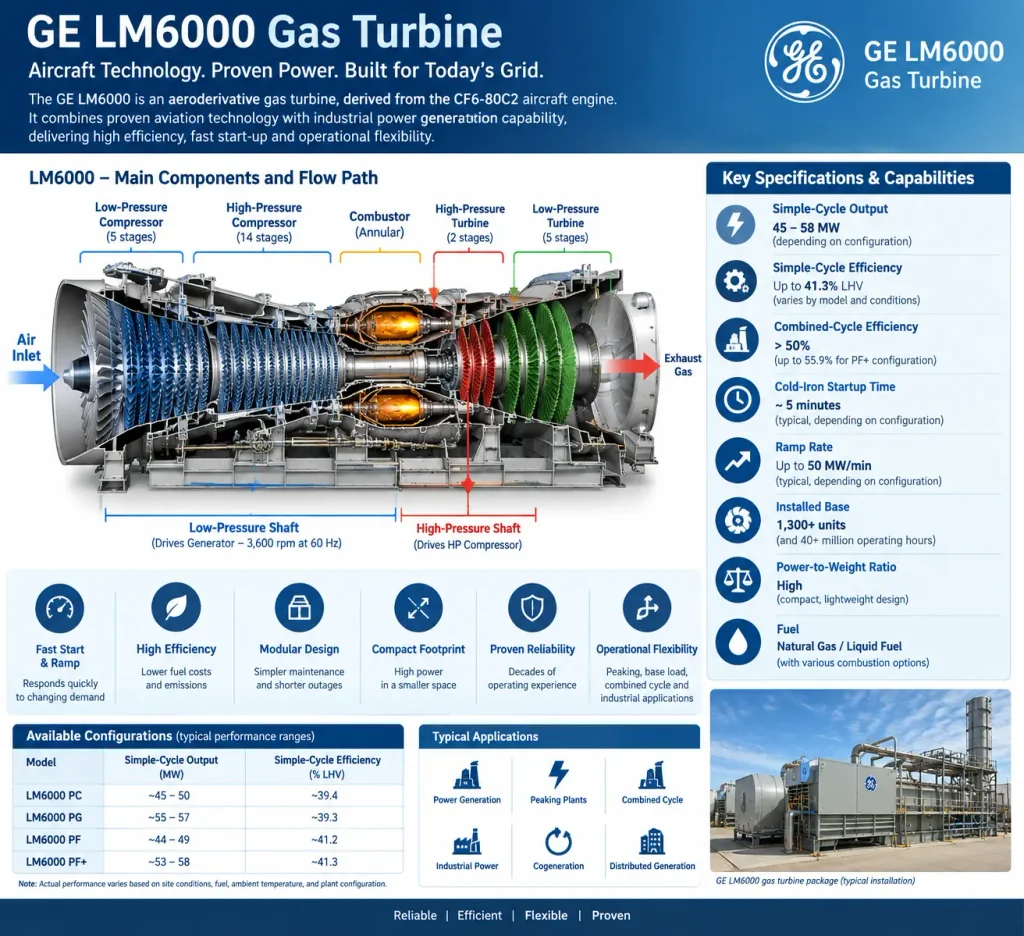
The engineering inside the machine is equally impressive. The LM6000 uses a twin-spool architecture with a low-pressure compressor, a 14-stage high-pressure compressor, an annular combustor, a two-stage high-pressure turbine, and a five-stage low-pressure turbine.
This article looks inside the GE LM6000 gas turbine, explains how it converts fuel into electricity, examines its major configurations, and discusses why maintenance, inspection, alignment, performance testing, and spare-parts planning remain important throughout the turbine’s operating life.
Table of Contents
From Aircraft Engine Technology to Power Generation
The LM6000 is an aeroderivative gas turbine. Instead of being developed entirely as a stationary industrial machine, it uses aircraft-derived technology adapted for power generation.
Its design heritage is associated with the CF6-80C2 aircraft engine family. The underlying engineering philosophy was developed around high power output, compact dimensions, reliability, and efficient operation.
Those characteristics are valuable in power generation as well.
Aircraft engines operate under demanding conditions where weight, efficiency, reliability, and component performance are critical. When similar engineering principles are applied to stationary generation, the result is a turbine with a relatively high power-to-weight ratio and a compact installation footprint.
The GE LM6000 has evolved through several generations and configurations. GE’s current published information reports more than 1,300 units shipped and more than 40 million operating hours across the LM6000 fleet.
That installed base also means that operators, engineers, maintenance specialists, and service organizations have accumulated decades of experience with the platform.
How the GE LM6000 Gas Turbine Works
At its simplest, a gas turbine follows the Brayton cycle:
Air intake → Compression → Combustion → Expansion through turbines → Mechanical power
In an LM6000 power generation package, the mechanical power produced by the turbine is converted into electricity through a generator.
The process can be broken into several major stages.
1. Air Enters the Low-Pressure Compressor
The process begins when ambient air enters the turbine through the inlet system.
The LM6000 has a five-stage low-pressure compressor. Its job is to begin compressing the incoming air before the air reaches the high-pressure compressor.
Variable geometry helps the compressor manage airflow under different operating conditions, including startup and load changes.
The quality of the inlet air matters significantly. Filters, inlet pressure losses, contamination, and environmental conditions can all affect compressor performance.
This is particularly important for turbines operating in dusty, humid, or industrial environments.
2. The High-Pressure Compressor Raises Air Pressure
After passing through the low-pressure compressor, the air enters the 14-stage high-pressure compressor.
The compressor progressively increases the pressure of the air before combustion.
This is one of the most important parts of the gas turbine because the compressor consumes a significant portion of the turbine’s internally generated power.
Compressor performance therefore directly influences overall turbine output and efficiency.
Deposits, erosion, fouling, damaged blades, or other deterioration can affect airflow and pressure ratio. For this reason, inspection and performance monitoring are important elements of long-term LM6000 maintenance.
3. Fuel Is Burned in the Combustor
The compressed air then enters the combustor.
Fuel is introduced and mixed with the compressed air before ignition. The resulting combustion process produces extremely hot, high-energy gases.
The LM6000 family has used different combustion technologies across its generations and configurations, including Dry Low Emissions technology.
Combustion technology is important not only for turbine performance but also for emissions compliance.
Fuel nozzles, combustion components, temperature monitoring, and control systems must operate correctly to maintain stable combustion and protect downstream turbine components.
4. The High-Pressure Turbine Extracts Energy
The hot gases leaving the combustor first pass through the high-pressure turbine.
The LM6000 uses a two-stage high-pressure turbine.
The high-pressure turbine extracts enough energy to drive the high-pressure compressor.
This section operates under extremely demanding thermal and mechanical conditions. Turbine blades and vanes are exposed to high temperatures, high rotational speeds, and significant aerodynamic loads.
Cooling systems, materials, coatings, seals, and component condition therefore have a direct relationship with turbine reliability and service life.
5. The Low-Pressure Turbine Produces the Output Power
After passing through the high-pressure turbine, the gas continues through the five-stage low-pressure turbine.
The low-pressure turbine drives the low-pressure compressor and provides the mechanical output used by the driven equipment.
In power generation applications, that output is connected to an electrical generator.
The final result is a continuous conversion of fuel energy into mechanical energy and then electrical energy.
The US Department of Energy describes this fundamental gas turbine process and explains how exhaust heat can also be recovered through an HRSG for combined-cycle generation.
Why the Twin-Spool Design Matters
One of the defining features of the LM6000 is its twin-spool architecture.
The high-pressure and low-pressure rotating assemblies operate independently rather than being locked to a single shaft speed.
This gives the turbine greater flexibility during startup, acceleration, load changes, and other operating conditions.
For power plant operators, that flexibility is valuable because electricity demand does not remain constant.
A generating unit may need to start quickly during a demand increase, respond to changes in grid conditions, or operate alongside renewable generation whose output varies with weather.
The LM6000 was designed around this type of flexibility.
GE’s current LM6000 data lists a cold-iron startup time of approximately five minutes and a ramp rate of up to 50 MW per minute, depending on configuration and operating conditions.
Actual plant performance can vary according to ambient conditions, turbine configuration, controls, fuel, plant systems, and operating state.
Why the LM6000 Is Suitable for Flexible Power Generation
The LM6000 has several characteristics that make it suitable for flexible generation.
Fast Startup
A turbine that can reach operating conditions quickly can respond to changes in electricity demand much faster than many conventional generation technologies.
This makes the LM6000 suitable for applications including:
- Peaking generation
- Reserve capacity
- Grid support
- Renewable energy balancing
- Industrial power generation
- Distributed generation
- Backup and emergency generation
High Power Density
The LM6000 can generate tens of megawatts from a relatively compact package.
This can be particularly useful where available land is limited or where a plant operator wants to add generating capacity without constructing an extremely large turbine installation.
Operational Flexibility
Modern power systems increasingly require generating equipment that can operate across different dispatch profiles.
GE’s current LM6000 specifications identify applications ranging from peaking to baseload, including simple-cycle generation, combined-cycle plants, industrial cogeneration, and district heating.
How Efficient Is the GE LM6000?
Efficiency varies according to the LM6000 model, ambient conditions, fuel, load, and plant configuration.
GE’s current published data lists simple-cycle output capabilities of approximately 45 to 58 MW across LM6000 PC, PG, PF, and PF+ configurations.
The published net simple-cycle efficiencies range from approximately 39.3% to 41.3% LHV across those configurations, with the PF and PF+ configurations reaching the higher end of that range.
These numbers should not be treated as universal field performance figures.
Actual output and efficiency can be affected by:
- Ambient temperature
- Atmospheric pressure
- Humidity
- Fuel composition
- Inlet pressure losses
- Exhaust backpressure
- Compressor condition
- Turbine condition
- Generator losses
- Auxiliary power consumption
- Operating load
This distinction is particularly important when comparing turbine performance at different sites.
Why Hot Weather Affects LM6000 Output
Gas turbines are strongly affected by ambient temperature.
As inlet air becomes hotter, its density decreases. Less air mass can therefore enter the compressor for a given volumetric flow.
The result can be reduced turbine output.
This is especially relevant for installations in hot climates.
Plant operators can use several approaches to manage the effect, depending on the turbine configuration and site requirements.
These may include:
- Inlet air cooling
- Compressor washing
- Effective filtration
- Inlet system optimization
- Performance monitoring
- Appropriate operating strategies
- SPRINT or other performance-enhancement systems
The objective is not simply to maximize output at one point in time. It is to maintain predictable performance throughout changing operating conditions.
What Is SPRINT?
SPRINT stands for Spray Intercooling.
The system uses water injection to cool the air entering the compressor.
When water evaporates into the inlet air, it absorbs heat. The resulting reduction in inlet air temperature increases air density and can allow more air mass to enter the compressor.
That additional airflow can increase turbine output, particularly when ambient temperatures are high.
The value of this technology is therefore most apparent during hot operating conditions, when a conventional gas turbine may experience significant output degradation.
LM6000 Variants
The LM6000 family has developed significantly over the years.
LM6000 PC
The LM6000 PC is one of the best-known configurations in the fleet.
GE’s current published data lists approximately 45 MW net output at one reference condition and approximately 50 MW at the alternate reference condition shown in its specification table. Net simple-cycle efficiency is listed at approximately 39.4% LHV.
LM6000 PG
The PG configuration provides higher output than the PC.
GE’s current data lists approximately 55 to 57 MW of net simple-cycle output, with approximately 39.3% net efficiency under the stated reference conditions.
LM6000 PF and PF+
The later PF and PF+ configurations provide further improvements in performance.
GE lists approximately 44 to 49 MW for the PF and approximately 53 to 58 MW for the PF+, with published simple-cycle efficiencies of approximately 41.2% and 41.3%, respectively.
The important point is that LM6000 performance should always be discussed in terms of the specific model and configuration rather than using one number for the entire family.
Simple Cycle vs. Combined Cycle
An LM6000 can operate in simple-cycle or combined-cycle configurations.
In simple-cycle operation, the turbine produces electricity and the hot exhaust eventually leaves the system.
However, that exhaust still contains substantial thermal energy.
A heat recovery steam generator, or HRSG, can capture some of that energy and use it to produce steam.
The steam can then drive a steam turbine to generate additional electricity.
The result is a combined-cycle plant.
The basic process becomes:
Gas turbine → Hot exhaust → HRSG → Steam turbine → Additional power
GE’s current LM6000 data lists combined-cycle net efficiencies above 50% for several configurations, with the published figures reaching approximately 55.9% for the PF+ configuration under the stated reference conditions.
The US Department of Energy also explains how HRSG systems recover gas turbine exhaust heat for steam generation in combined-cycle plants.
Maintenance Is Critical to LM6000 Performance
A gas turbine’s nameplate rating does not guarantee that the machine will continue delivering the same performance throughout its operating life.
Actual performance depends heavily on component condition and maintenance quality.
Important areas include:
- Compressor condition
- Turbine blade and vane condition
- Combustion system condition
- Fuel system performance
- Bearing condition
- Shaft alignment
- Vibration levels
- Instrumentation accuracy
- Inlet filtration
- Exhaust system condition
- Operating history
For this reason, maintenance should be based on operating hours, starts, condition monitoring, inspection findings, manufacturer recommendations, and the specific operating profile of the turbine.
Borescope Inspection
Borescope inspection allows engineers to examine internal turbine components without completely dismantling the machine.
It can help identify:
- Compressor blade damage
- Foreign object damage
- Deposits
- Erosion
- Cracking
- Combustion deterioration
- Turbine blade and vane condition
Early identification of deterioration can help operators plan corrective work before a developing problem becomes a major forced outage.
MEITICS provides GE gas turbine maintenance and inspection services, including borescope inspection, engine change, laser alignment, vibration monitoring, and related engineering support.
Engine Change and Major Maintenance
One of the important advantages of an aeroderivative platform is its modular maintenance philosophy.
Major maintenance may require removal and replacement of an engine or major module rather than performing every activity inside the power plant.
However, an engine change is a complex engineering operation.
It requires careful planning covering:
- Lifting arrangements
- Engine removal
- Transportation
- Installation
- Mechanical connections
- Alignment
- Auxiliary systems
- Instrumentation
- Controls
- Inspection
- Startup
- Performance testing
MEITICS has documented LM6000 project experience involving engine changes, hot-section exchanges, borescope inspections, laser alignment, power-loss investigation, startup, and performance testing across multiple international projects.
Laser Alignment and Vibration Monitoring
Alignment is another important consideration in rotating equipment.
Incorrect alignment between connected equipment can contribute to vibration, bearing loading, coupling problems, and premature component wear.
Precision laser alignment provides engineers with a method for accurately checking and correcting alignment.
Vibration monitoring provides another layer of condition information.
Changes in vibration can indicate problems such as:
- Rotor imbalance
- Misalignment
- Bearing deterioration
- Mechanical looseness
- Structural problems
- Other developing rotating-equipment issues
These techniques are particularly valuable when used as part of a broader condition-based maintenance program.
Instrumentation and Controls Matter Too
Mechanical condition is only part of turbine reliability.
The instrumentation and control system is responsible for monitoring and controlling many critical operating parameters.
Sensors and control systems provide information relating to temperatures, pressures, speeds, combustion conditions, and other operating variables.
Problems with instrumentation can therefore create operational issues even when the major mechanical components remain physically sound.
MEITICS provides instrumentation and control services for GE LM6000 and other gas turbine platforms, including combustion temperature control system inspection and related instrumentation maintenance.
Spare Parts and Inventory Can Affect Turbine Availability
A technically reliable turbine can still remain unavailable if a critical component is not available when required.
This makes spare-parts planning an important part of turbine maintenance strategy.
Critical components may include:
- Fuel system components
- Sensors
- Bearings
- Seals
- Filters
- Combustion components
- Turbine hardware
- Control system components
- Specialized consumables
- Major replacement modules
For older turbine fleets, procurement planning can become particularly important because some components may have long lead times or require specific certification and traceability.
Inventory records also need to be accurate.
If a maintenance team believes a critical component is available in the warehouse but the physical item cannot be found, the problem is no longer simply an inventory issue. It can become an equipment availability issue.
For organizations looking to strengthen inventory accuracy, spare-parts control, and inventory optimization, Safe Chain Solver provides specialized inventory consulting and reconciliation services. Its inventory optimization approach includes physical-to-system reconciliation, cycle counting, inventory accuracy monitoring, and identification of slow-moving and obsolete stock.
MEITICS itself also provides gas turbine spare-parts sourcing and identifies LM6000-related components among the equipment it supports.
Why Procurement and Engineering Must Work Together
Technical procurement for a gas turbine cannot always be treated like ordinary purchasing.
A critical component may require verification of:
- Part number
- Technical specification
- Compatibility
- Certification
- Traceability
- Condition
- Warranty
- Supplier capability
- Lead time
- Transportation requirements
An inexpensive component that arrives late can be far more costly than a properly planned purchase made in advance.
The same applies to major outage planning.
If a component has a long manufacturing lead time, identifying the requirement after the turbine has already been dismantled may create unnecessary downtime.
Engineering, maintenance, procurement, warehouse, and operations teams therefore need to work together when planning major turbine maintenance.
MEITICS and GE LM6000 Engineering Support
The GE LM6000 is one of the turbine platforms in which MEITICS has developed significant project experience.
MEITICS identifies LM6000 work across Pakistan and international markets, including projects involving:
- Engine change
- Hot-section exchange
- Borescope inspection
- Laser alignment
- Compressor blade replacement
- Fuel nozzle flow testing
- SAI and AI maintenance
- Generator bearing inspection
- Vibration monitoring
- Startup
- Performance testing
Projects listed by MEITICS include GE LM6000 work at the K-Electric Korangi Power Complex in Pakistan, LOTTE Chemical Pakistan, Habibullah Coastal Power in Quetta, East Delta Electricity in Egypt, LUK Oil in Russia, Aksa Energy in Uzbekistan, and PT MEDCO Power in Indonesia.
This experience reflects an important reality of gas turbine maintenance: successful execution requires more than knowledge of the turbine itself. It requires coordinated engineering, planning, field execution, inspection, alignment, commissioning, and documentation.
The LM6000 in Today’s Power Sector
The LM6000 remains relevant because power systems increasingly need flexible generating assets.
Renewable generation has expanded significantly, but solar and wind output varies according to environmental conditions.
Flexible gas turbine technology can therefore play a role in balancing generation portfolios where appropriate.
The LM6000 combines several characteristics that support this role:
- Rapid startup
- High ramp capability
- Compact footprint
- Simple-cycle flexibility
- Combined-cycle capability
- Mature operating history
- Broad installed base
- Established maintenance knowledge
GE’s current LM6000 documentation describes the platform as capable of operating across different dispatch profiles, from peaking to baseload applications.
Conclusion
The GE LM6000 gas turbine represents an important example of how aircraft-derived engineering can be adapted successfully for power generation.
Its twin-spool architecture, high-pressure compressor, annular combustor, high-pressure turbine, and low-pressure turbine work together to convert fuel energy into mechanical and electrical power.
Its value, however, is not determined by design specifications alone.
Long-term performance depends on turbine condition, compressor cleanliness, combustion performance, alignment, vibration, instrumentation, inspection quality, maintenance planning, spare-parts availability, and the ability to execute outages efficiently.
That is why LM6000 maintenance is a multidisciplinary activity.
From borescope inspection and engine changes to laser alignment, vibration monitoring, instrumentation, startup, performance testing, and spare-parts sourcing, each activity contributes to the overall reliability of the generating asset.
MEITICS Engineering Services provides specialized engineering support for GE aero-derivative gas turbines, including the LM6000, with experience across power generation and industrial projects in Pakistan and international markets.
For operators, the objective is straightforward: keep the turbine safe, reliable, efficient, and available when the power system needs it.