
Introduction
Industrial engineering problems are not always as straightforward as they first appear.
A machine may be vibrating without an obvious mechanical failure. A motor may be drawing abnormal current without showing visible damage. A process may be producing inconsistent results even though the major equipment appears to be operating normally. An instrumentation problem may even be mistaken for a mechanical or process problem.
In industrial environments, the visible symptom is not necessarily the actual cause.
Understanding what is happening, identifying the contributing factors, and determining why a problem has developed are therefore essential steps before deciding what action to take.
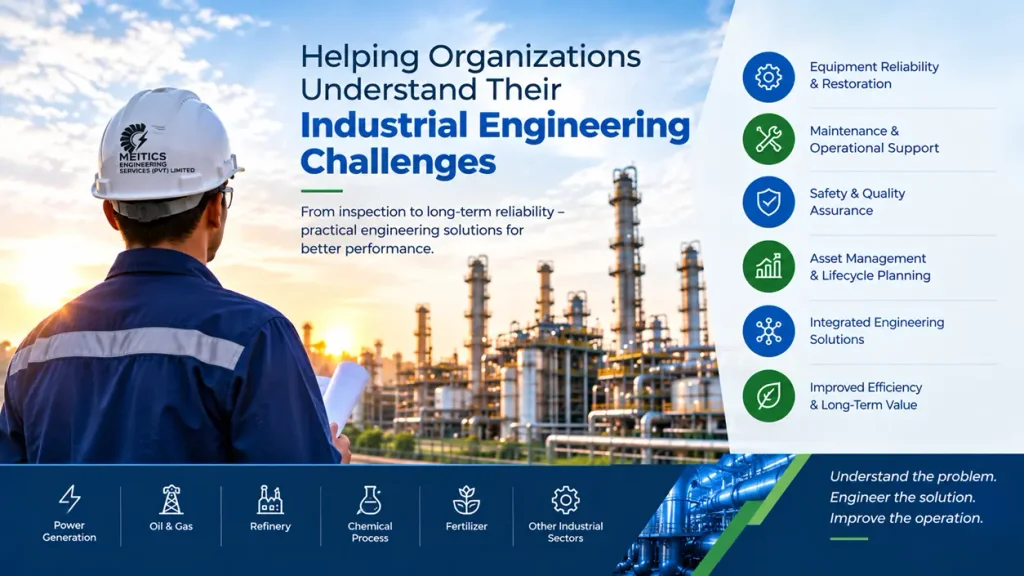
At MEITICS Engineering Services (Pvt.) Limited, we approach industrial engineering challenges by looking beyond the immediate symptom. Our engineering services support mechanical, electrical, instrumentation and control, gas turbine, and other industrial requirements, helping organizations investigate technical problems and develop practical engineering responses.
The objective is simple: understand the problem before committing to the solution.
Table of Contents
Why Industrial Engineering Problems Are Often Misunderstood
Industrial equipment rarely operates in isolation.
A rotating machine can be affected by alignment, foundation condition, lubrication, loading, connected equipment, operating speed, or process conditions. An electrical issue can be influenced by power quality, connections, insulation, loading, or control systems.
Similarly, an instrumentation problem may originate from the instrument itself, calibration, wiring, signal transmission, configuration, or the process being measured.
This means that replacing the component showing the symptom does not always solve the actual problem.
For example, repeatedly replacing a bearing without investigating why the bearing is failing can result in continued breakdowns and unnecessary maintenance expenditure.
The important question is therefore not simply:
“What failed?”
It is:
“What caused it to fail?”
That distinction is fundamental to effective industrial engineering.
Symptoms Are Not Always the Root Cause
One of the most important principles in industrial engineering troubleshooting is distinguishing between a symptom, a failure mechanism, and the underlying cause.
Consider excessive vibration in a rotating machine.
The vibration is the symptom. The underlying problem could involve:
- Misalignment
- Imbalance
- Bearing condition
- Foundation or mounting problems
- Mechanical looseness
- Coupling problems
- Operating conditions
- Resonance
- Installation errors
Replacing a component simply because it is showing signs of distress may provide temporary improvement while leaving the original cause unresolved.
A more effective engineering investigation considers the complete chain:
Symptom → Evidence → Failure mechanism → Root cause → Corrective action
This approach can help organizations avoid repeatedly treating the same problem.
Start With Evidence, Not Assumptions
Industrial troubleshooting should be based on evidence wherever practical.
Before deciding that equipment needs repair or replacement, engineers may need to understand:
- What changed before the problem appeared?
- When does the problem occur?
- Does it occur continuously or intermittently?
- Under what operating load or conditions?
- Has the equipment experienced similar problems before?
- What do inspection and test results show?
- Have recent modifications or repairs been made?
- Are connected systems contributing to the problem?
- What does the equipment’s operating history indicate?
This information creates a clearer technical picture.
Depending on the equipment and problem, the investigation may involve visual examination, dimensional checks, electrical testing, vibration measurement, infrared thermography, alignment verification, balancing, calibration, NDT inspection, performance measurements, or other diagnostic techniques.
MEITICS provides Inspection & Diagnostics Services including laser alignment, vibration analysis, field balancing, infrared thermography, and NDT inspection.
The purpose of these activities is not simply to collect measurements. The information must be interpreted in the context of the equipment, operating conditions, and failure history.
Mechanical Engineering Problems Require More Than Visual Inspection
Many mechanical problems develop gradually before becoming a major failure.
A machine may continue operating while experiencing increasing vibration, wear, temperature, misalignment, imbalance, lubrication problems, or deterioration of components.
Visual inspection alone may not reveal the full condition.
For rotating equipment, for example, vibration analysis can provide useful information about developing mechanical conditions. Alignment checks can identify geometric conditions that may contribute to premature wear. Balancing can address excessive rotating imbalance. Thermography can help identify abnormal temperature patterns in suitable applications.
The appropriate diagnostic method depends on the equipment and the suspected problem.
This is why engineering investigation should be problem-specific rather than based on a one-size-fits-all checklist.
Electrical and Instrumentation Problems Can Have Hidden Causes
Electrical and control-system problems can also be difficult to diagnose because the visible failure may occur downstream from the actual cause.
An electrical problem may involve:
- Excessive loading
- Loose or deteriorated connections
- Insulation problems
- Power-quality issues
- Motor condition
- Protection settings
- Wiring
- Control circuits
Instrumentation problems can similarly involve:
- Incorrect calibration
- Sensor deterioration
- Wiring faults
- Signal problems
- Configuration issues
- Control-system logic
- Environmental conditions
A process disturbance may therefore appear to be an equipment problem when the actual cause lies elsewhere in the system.
A multidisciplinary approach can be particularly valuable when mechanical, electrical, instrumentation and process factors interact.
Root Cause Analysis Helps Prevent Repeated Problems
A structured approach to equipment failure investigation also benefits from consistent reliability and maintenance data. ISO 14224:2016, developed for the petroleum, petrochemical and natural gas industries, provides a standardized basis for collecting equipment, failure and maintenance data, including failure causes, consequences, maintenance actions and downtime. This type of structured information can support better reliability analysis and more informed engineering decisions.
If the same pump, motor, compressor, turbine component, electrical connection, or instrumentation device repeatedly develops problems, the organization should consider whether the underlying failure mechanism has been properly identified.
Root Cause Analysis (RCA) provides a structured way to investigate why an unwanted event occurred and what factors contributed to it.
The investigation may consider:
- What happened?
- What evidence is available?
- What changed before the event?
- What physical or technical mechanism produced the failure?
- What conditions allowed that mechanism to develop?
- What corrective action can address the underlying cause?
- How can the effectiveness of the corrective action be verified?
This is more valuable than simply recording:
“Component failed — component replaced.”
A stronger engineering record explains why the component failed and what was done to prevent recurrence.
Engineering Decisions Should Follow the Diagnosis
Once the problem has been properly investigated, several solutions may be possible.
Depending on the findings, the appropriate response could involve:
- Adjustment
- Alignment
- Calibration
- Repair
- Component replacement
- Balancing
- Refurbishment
- Process modification
- Control-system correction
- Operating-condition changes
- Further monitoring
- A larger engineering intervention
The lowest-cost option is not necessarily the best option.
Likewise, replacing an entire piece of equipment is not automatically the most technically appropriate decision.
The engineering response should consider the actual failure mechanism, operational requirements, safety implications, expected performance, implementation requirements, and overall cost.
This allows organizations to make decisions based on engineering evidence rather than assumptions.
When a Problem Requires Multidisciplinary Engineering
Some industrial engineering problems cannot be isolated to one discipline.
A vibration problem may involve mechanical alignment but also be influenced by electrical loading or process conditions.
A gas turbine issue may require mechanical, electrical, instrumentation and operational understanding.
A control problem may require investigation of the instrument, wiring, control logic and process behaviour together.
This is where multidisciplinary engineering capability becomes important.
MEITICS supports industrial organizations across areas including mechanical engineering, electrical systems, instrumentation and control, gas turbines and BOP Equipment Services.
The objective is not to apply every discipline to every problem. It is to involve the right technical expertise when the problem crosses disciplinary boundaries.
From Technical Findings to Practical Action
A good engineering investigation should ultimately lead to an actionable recommendation.
Technical findings are useful only when they help an organization decide what to do next.
A practical engineering report or assessment should, where appropriate, establish:
Observed condition → Technical finding → Likely cause → Risk/impact → Recommended action → Verification
This creates a useful connection between engineering analysis and operational decision-making.
For management, this can make technical information easier to understand and act upon.
For maintenance teams, it can provide clearer direction.
For engineering teams, it can establish a documented basis for corrective action.
Avoiding the Cost of Treating Symptoms
Repeated temporary fixes can become expensive.
Consider an industrial machine that repeatedly experiences a coupling problem. If the coupling is replaced each time without checking alignment, foundation condition, installation practices, connected equipment, or operating conditions, the organization may continue spending money without eliminating the underlying cause.
The same principle applies to electrical, instrumentation and process problems.
A short-term repair may sometimes be necessary to restore operation. However, organizations should distinguish between:
Restoring operation now
and
Eliminating the reason the problem occurred.
The first may be an immediate operational requirement.
The second is what helps prevent recurrence.
Good engineering recognizes the difference.
Connecting Engineering Understanding With Operational Performance
Industrial engineering decisions ultimately affect more than equipment.
An unresolved technical problem can lead to:
- Production interruption
- Reduced equipment availability
- Higher maintenance costs
- Emergency procurement
- Increased spare-parts consumption
- Safety exposure
- Unplanned manpower requirements
- Loss of production capacity
For this reason, engineering investigations should consider the operational consequences of the problem as well as the technical cause.
MEITICS’ Operation & Maintenance capabilities support organizations in developing more structured approaches to maintaining and operating industrial equipment.
The goal is not simply to generate a technical report. It is to help the organization make a better operational decision.
When Organizations Need an Engineering Partner
Industrial organizations often have capable maintenance and engineering teams. However, specialized problems may require additional diagnostic equipment, independent assessment, specialist knowledge, or multidisciplinary expertise.
An external engineering partner can provide focused support during situations such as:
- Recurring equipment failures
- Difficult troubleshooting
- Major equipment problems
- Condition assessment
- Precision alignment
- Vibration investigations
- Electrical or instrumentation issues
- Shutdowns and major maintenance activities
- Equipment performance concerns
- Root cause investigations
- Engineering assessments before repair or replacement
The most useful engineering partner does not simply recommend a service.
The partner should first understand the problem, examine the available evidence, communicate the findings clearly, and recommend an appropriate course of action.
A Practical Framework for Industrial Engineering Problem-Solving
Organizations can use a simple framework when approaching an unfamiliar engineering problem:
1. Define the problem
Clearly describe what is happening, where it is happening, and what operational impact it is creating.
2. Establish the evidence
Review inspection results, operating data, maintenance history, previous failures, measurements and relevant equipment information.
3. Identify possible causes
Develop realistic technical hypotheses instead of immediately assuming the first visible component is responsible.
4. Test the hypotheses
Use appropriate inspection, measurement, testing and engineering analysis to determine which causes are supported by evidence.
5. Determine the corrective action
Select an intervention that addresses the identified cause and fits the operational requirements.
6. Verify the result
After corrective action, monitor the equipment or process to confirm that the problem has actually been resolved.
This creates a disciplined approach:
Define → Investigate → Diagnose → Correct → Verify
MEITICS Engineering Services
MEITICS Engineering Services (Pvt.) Limited supports industrial organizations facing complex engineering requirements and equipment-related challenges.
Its capabilities cover areas including mechanical engineering, electrical systems, instrumentation and control, gas turbine-related requirements, inspection and diagnostics, BOP equipment, operation and maintenance, and related industrial engineering services.
The emphasis is on understanding the technical requirement before recommending an intervention.
Whether an organization needs help investigating a recurring equipment problem, assessing an abnormal condition, carrying out specialized inspection, or determining the appropriate engineering response, a structured diagnostic approach can help reduce uncertainty and improve decision-making.
Conclusion
Industrial engineering challenges are often more complex than the visible symptom suggests.
A failed component may be the result rather than the cause. An abnormal reading may originate from another part of the system. A recurring maintenance problem may indicate an unresolved engineering condition.
Understanding these relationships is the foundation of effective industrial problem-solving.
By combining inspection, measurement, technical analysis, multidisciplinary expertise and root cause thinking, organizations can move beyond temporary fixes toward more informed engineering decisions.
The objective is not always to repair the first component that fails.
It is to understand what happened, why it happened, what should be done, and how the result can be verified.
MEITICS helps organizations understand their industrial engineering challenges and develop practical responses based on evidence, engineering judgment and operational requirements.
Understand the symptom. Find the cause. Engineer the right response.