
Introduction
GE gas turbines play a vital role in power generation, oil and gas operations, and industrial facilities around the world. Known for their high power output, operational flexibility, and advanced engineering, these machines are used where reliable and efficient power is essential.
However, achieving maximum performance from a gas turbine requires more than simply operating the equipment. Effective maintenance, accurate diagnostics, timely inspections, and access to experienced engineering support are critical to maintaining reliability throughout the turbine’s operational life.
Table of Contents
Understanding GE Gas Turbines
A gas turbine converts the energy released from fuel combustion into mechanical power. This power can then drive an electrical generator, compressor, pump, or other industrial equipment.
GE has developed a wide range of gas turbine technologies for different applications, including aero-derivative turbines used for:
- Power generation
- Oil and gas operations
- Industrial facilities
- Emergency and mobile power applications
- Offshore and remote installations
GE Aero-derivative gas turbines are particularly valued for their high power-to-weight ratio, rapid installation capabilities, and operational flexibility.
The Importance of Reliable GE Gas Turbines Maintenance
Gas turbines operate under demanding conditions involving high temperatures, rotational speeds, pressure, and vibration. Even minor issues can gradually affect efficiency and potentially lead to unplanned outages. GE Vernova provides detailed technical information on the LM2500 aero-derivative turbine family.
A structured gas turbine maintenance services strategy helps operators not only improve equipment availability and reduce the risk of unplanned outages but:
- Improve equipment availability
- Reduce the risk of unexpected failures
- Identify developing faults at an early stage
- Optimize turbine performance
- Extend component service life
- Reduce long-term maintenance costs
Maintenance planning should be based on the turbine’s operating profile, condition, manufacturer recommendations, and inspection findings.
Key Maintenance Activities for GE Gas Turbines
1. Borescope Inspection
Borescope inspections allow engineers to visually examine internal turbine components without extensive dismantling.
This can help identify potential issues involving:
- Compressor blades
- Combustion components
- Turbine blades and vanes
- Foreign object damage
- Deposits and deterioration
Regular borescope inspection services allow engineers to examine critical internal components without extensive dismantling.
2. Engine Change and Module Replacement
Certain maintenance requirements may involve engine changes or the replacement of major turbine modules.
These activities require detailed planning and precise execution to ensure:
- Safe lifting and handling
- Correct mechanical alignment
- Proper connection of auxiliary systems
- Accurate installation procedures
- Successful commissioning and startup
Experienced engineering support is particularly important during outage periods, where project duration directly affects plant availability.
3. Laser Alignment
Incorrect alignment between the gas turbine and driven equipment can contribute to vibration, bearing problems, and premature component wear.
Laser alignment provides a precise method for checking and correcting equipment alignment.
Benefits include:
- Reduced vibration
- Improved equipment reliability
- Lower bearing and coupling stress
- Better operational performance
Correct precision laser alignment helps reduce vibration and mechanical stress between connected equipment
4. Vibration Monitoring and Analysis
Vibration is one of the most important indicators of rotating equipment health.
Regular vibration monitoring can help engineers detect potential problems associated with:
- Rotor imbalance
- Misalignment
- Bearing deterioration
- Mechanical looseness
- Structural issues
Condition-based monitoring allows maintenance teams to investigate developing problems before they result in an unexpected shutdown.
Why Independent Service Providers Matter
Many gas turbine operators require flexibility in how they manage maintenance, outages, engineering services, and spare parts.
An Independent Service Provider (ISP) can provide an alternative support model for operators seeking specialized technical services without necessarily entering into long-term service arrangements.
The ISP approach can offer advantages such as:
- Flexible project-based support
- Specialized engineering expertise
- Faster mobilization for regional projects
- Transparent scope definition
- Support for planned and unplanned outages
- Competitive sourcing options for maintenance requirements
The right service partner should combine technical capability with a clear understanding of the customer’s operational priorities.
Supporting GE Gas Turbines Operations Across the Region
Gas turbine projects often require a combination of mechanical, electrical, instrumentation, and diagnostic expertise.
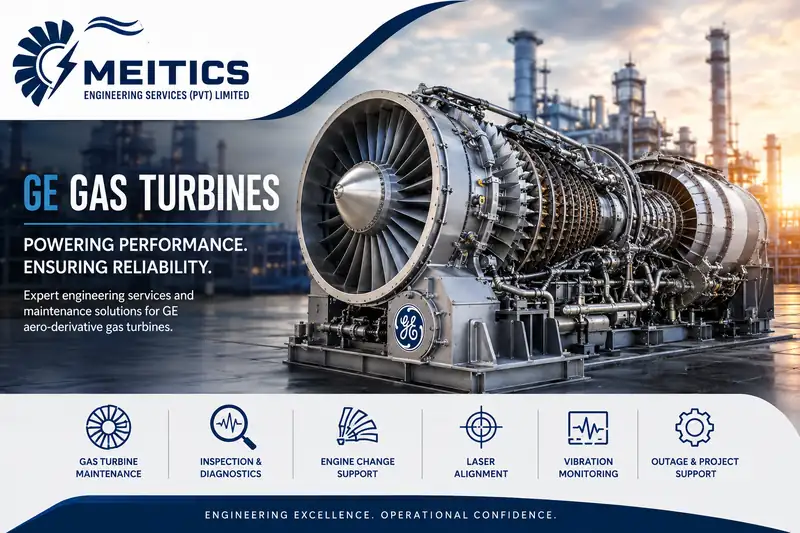
MEITICS Engineering Services Pvt Ltd provides specialized engineering support for gas turbine and industrial operations, including:
- Gas turbine maintenance
- Engine change support
- Hot section activities
- Borescope inspection
- Laser alignment
- Vibration monitoring
- Startup and commissioning support
- Performance testing
- Inspection and diagnostics
- Spare parts sourcing
With project experience across multiple international markets, MEITICS supports customers requiring responsive and technically focused engineering services.
Reducing the Risk of Unplanned Outages
Unplanned outages can have significant operational and financial consequences. The best strategy is not simply responding when a failure occurs but developing a proactive maintenance and inspection approach.
Operators should focus on:
- Establishing clear maintenance intervals.
- Monitoring critical operating parameters.
- Performing condition assessments.
- Investigating abnormal vibration and performance trends.
- Planning outages in advance.
- Ensuring access to qualified engineering resources.
- Maintaining an effective spare parts strategy.
A proactive approach improves the ability to identify potential problems before they become critical.
The Future of Gas Turbine Support
As power and industrial operations continue to demand higher reliability and cost efficiency, turbine operators increasingly require flexible and responsive engineering support.
The future of gas turbine maintenance will continue to place greater emphasis on:
- Condition-based maintenance
- Advanced diagnostics
- Performance monitoring
- Predictive maintenance strategies
- Faster outage execution
- Improved spare parts planning
- Independent technical support
The objective remains the same: maximizing equipment availability while managing maintenance costs and operational risk.
Conclusion
GE gas turbines remain essential assets across power generation, oil and gas, and industrial operations. Their reliability and performance depend heavily on effective maintenance, accurate diagnostics, and experienced engineering support.
From routine inspections and laser alignment to engine changes and outage support, a structured maintenance strategy can help operators improve availability, reduce operational risk, and protect the long-term value of critical turbine assets.
MEITICS Engineering Services Pvt Ltd provides specialized gas turbine engineering services to support reliable and efficient operations across Pakistan, the GCC, and international markets.